What Happens During an Epoxy Floor Installation
Twenty minutes into grinding, the slab turns from glossy gray to a flat, even tooth, and every later coat depends on that surface. A garage floor in Riverside, CA gets the same treatment as a shop bay, with overlapping passes and a HEPA vacuum right behind the grinder, as the notes at epoxy floor installation riverside clytemnestra project describe. Epoxy bonds to concrete that is open and clean, and to nothing else.
Clearing and grinding
The space is emptied first, down to the shelving brackets and the paint cans in the corner. Diamond grinding removes sealers, laitance and old adhesive, and it opens the pores so the primer can soak in. Santa Ana winds push fine dust through any open door, so the bay stays closed and the vacuum runs until the slab shows no film under a hand wipe.
Cracks, joints and pits
Every crack is routed or opened slightly, then filled with a rigid epoxy or polyurea filler. Pits and spalls get patched flush. Once the filler cures, it is ground smooth, because a ridge under the base coat will telegraph through the finished surface and catch the light like a scar.
Mixing and pouring
Epoxy is resin and hardener, and it cures by chemical reaction, not by drying. The ratio is measured, not guessed. Extra hardener does not make it stronger, it leaves a soft, tacky film that never fully sets. After mixing, the pot life is short and the heat builds inside the bucket, so the batch is poured out in a ribbon and not left sitting. A July afternoon in the Inland Empire shortens that window further.
Base coat and broadcast
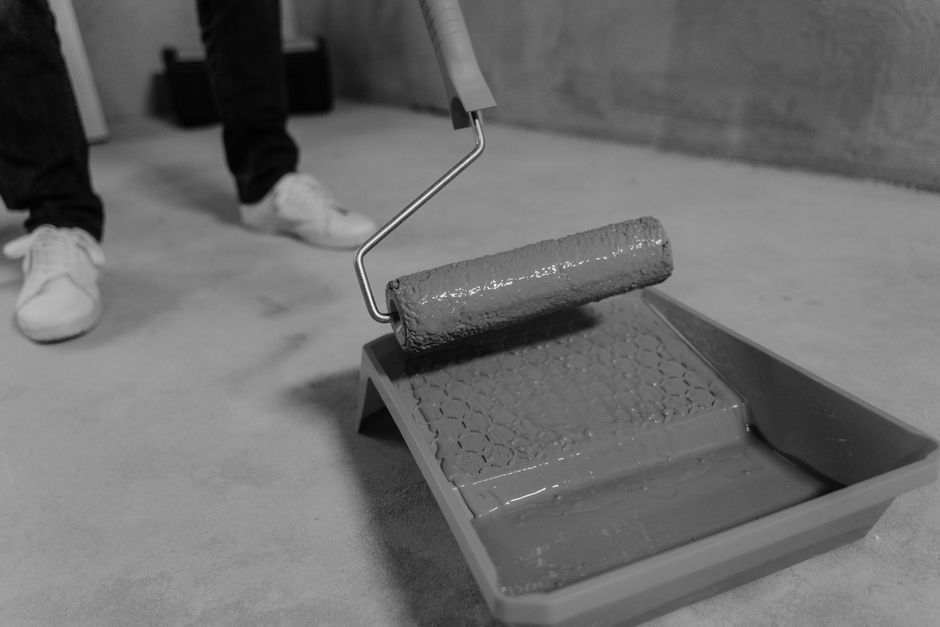
The base coat is pulled out with a squeegee and back rolled to an even thickness. While it is wet, the crew will broadcast vinyl flake or quartz sand by hand, tossed high so it falls flat and covers to rejection. A metallic pigment or a solid color base follows the same sequence, just without the broadcast. After the base cures, loose flake is scraped and vacuumed off.
Topcoat and recoat window
A clear coat seals the broadcast and locks the flake in place. Urethane and polyaspartic are the common topcoat choices, and both resist abrasion and yellowing better than the epoxy underneath. Each layer has a recoat window. If it passes, the surface is scuffed with an abrasive pad or a light grind so the next coat has something to grip.
Return to service
Light foot traffic is usually fine within about a day. Vehicles wait several days, and the exact count depends on the product and the temperature of the slab, not the air. A floor that felt hard at dusk can still print a hot tire in the morning, so the car stays out until the topcoat has had its full cure.